June 18, 2026
August 12, 2026
Tokenization is no longer a whitepaper concept. It is a balance-sheet reality. From tokenized money market funds to blockchain-based structured notes, the digitization of financial instruments is moving from pilot projects to production environments. According to the Boston Consulting Group, tokenized assets could reach trillions of dollars in value by the end of the decade, and major global institutions have already issued tokenized bonds and funds on public and permissioned blockchains. The infrastructure is here. The liquidity is forming. The regulatory scrutiny is intensifying.
For firms distributing tokenized products into the European retail market, the question is no longer whether innovation is possible. The question is whether it is compliant. At the center of that compliance sits the PRIIPs Key Information Document (KID) and, in particular, the performance scenarios framework. PRIIPs performance scenarios for tokenized products are not a cosmetic exercise. They are a quantitative representation of what an investor “might get back,” under standardized favorable, moderate, unfavorable, and stress conditions. Get them wrong, and you do not just risk regulatory findings. You risk mis-selling.
This article is designed for finance professionals who understand both capital markets and blockchain infrastructure. We will dissect how PRIIPs performance scenarios apply to tokenized securities, tokenized funds, wrapped assets, and structured digital notes. We will address modeling complexities, cost disclosures, governance controls, and token-specific mechanics. Most importantly, we will translate regulation into actionable implementation strategy.
PRIIPs, or Packaged Retail and Insurance-based Investment Products, is a European regulatory framework designed to enhance transparency for retail investors. It mandates a standardized Key Information Document for products that package or wrap underlying exposures in a way that exposes investors to market risk. If you are distributing tokenized financial instruments to EU retail clients, you are likely in scope. The fact that a product lives on-chain does not move it outside the perimeter.
Tokenization does not change the economic nature of a product. It changes its wrapper, settlement mechanics, and sometimes its liquidity profile. From a PRIIPs perspective, what matters is whether the investor’s return depends on the performance of one or more underlying assets and whether the investor bears market risk. In practice, many tokenized products fall squarely within that definition.
PRIIPs applies when a product is made available to retail investors in the European Economic Area and its value fluctuates because of exposure to underlying assets. Structured products, derivatives, funds, and certain insurance-based products are classic examples. The obligation to produce a PRIIPs KID typically falls on the manufacturer of the product, not the distributor.
If a token represents a security, a fund share, a structured payoff, or a derivative exposure, and it is marketed to retail clients in the EU, a KID is generally required. The digital nature of issuance does not exempt it. In fact, regulators have been clear that technology-neutral application is the norm. If it walks like a structured product and quacks like a structured product, it needs a KID—even if it settles on a blockchain.
The term “tokenized product” is broad. In practice, it covers multiple categories of financial instruments whose rights and economic exposure are recorded or transferred using distributed ledger technology. For PRIIPs performance scenarios for tokenized products, classification drives methodology. You cannot model what you have not properly defined.
Tokenized securities represent traditional equity or debt instruments in digital form. A tokenized bond issued on a blockchain with periodic coupon payments and redemption at maturity is economically identical to its conventional counterpart. The risk lies in interest rate movements, issuer credit quality, and liquidity—not in the blockchain per se.
For PRIIPs modeling, these products are generally treated like transferable securities. Performance scenarios must reflect price volatility, yield movements, and credit risk. If the token is tradeable on a digital exchange, secondary market pricing dynamics must also be reflected, particularly where liquidity is thinner than in traditional venues.
Several global asset managers have launched tokenized money market funds and tokenized share classes of existing funds. The underlying portfolio may consist of short-term government securities or diversified equities, but the ownership record is maintained on-chain. Investors subscribe and redeem using digital wallets.
From a PRIIPs standpoint, these are typically treated as UCITS or AIF exposures, depending on structure. Performance scenarios must reflect the net asset value dynamics of the underlying portfolio. However, token-specific features—such as transfer restrictions or blockchain settlement windows—can introduce additional liquidity considerations that should be factored into stress scenarios.
Structured products are where complexity escalates. A tokenized autocallable note with a barrier and digital coupon behaves no differently economically because it is issued as a smart contract. It still embeds optionality and path dependency. The modeling challenge lies in capturing non-linear payoffs accurately under the PRIIPs scenario framework.
For these products, PRIIPs performance scenarios must incorporate volatility assumptions, barrier probabilities, and early redemption triggers. Digital issuance can introduce additional features—such as automated payout via smart contract—but the payoff mechanics remain central.
Wrapped assets, such as tokenized representations of equities or commodities, introduce another layer. The investor’s exposure depends on the underlying reference asset and the integrity of the wrapping mechanism. Synthetic tokens may track an index or commodity through derivative contracts or collateral pools.
Under PRIIPs, the economic exposure drives the classification. If the wrapped asset exposes the investor to price movements of an underlying instrument, it likely qualifies as a packaged product. Scenario modeling must consider not only market performance but also potential deviations between token price and underlying asset value.
PRIIPs performance scenarios for tokenized products rely on a standardized methodology defined in regulatory technical standards. These scenarios are not forecasts. They are standardized projections derived from historical data or simulations. Understanding the underlying concepts is critical to credible modeling.
The recommended holding period (RHP) reflects the minimum time horizon over which the product is designed to be held. For structured notes, this may align with maturity. For open-ended tokenized funds, it may reflect investment strategy.
The RHP anchors the time horizons for performance scenarios. Scenarios must be shown for intermediate points and the RHP. In tokenized markets, where 24/7 trading may encourage shorter holding periods, manufacturers must resist the temptation to shorten the RHP artificially. It should reflect economic design, not trading convenience.
The Summary Risk Indicator (SRI) ranks products on a scale from 1 to 7, based on market and credit risk. Tokenized products do not receive a “crypto premium” or “blockchain discount” automatically. The SRI depends on volatility and risk metrics derived from the underlying exposure.
Consistency between the SRI and performance scenarios is essential. A product with high volatility should display wider dispersion between favorable and unfavorable scenarios. If the SRI signals high risk but scenarios appear benign, regulators will notice the inconsistency.
Market risk is typically captured through volatility modeling, while credit risk reflects the likelihood of default by the issuer or guarantor. For tokenized debt instruments, both components are relevant. For synthetic exposures, counterparty risk in derivative structures may dominate.
Tokenization adds operational layers but does not eliminate credit risk. If a tokenized note is issued by a special purpose vehicle, scenario modeling must incorporate the creditworthiness of that entity. Blockchain immutability does not immunize against insolvency.
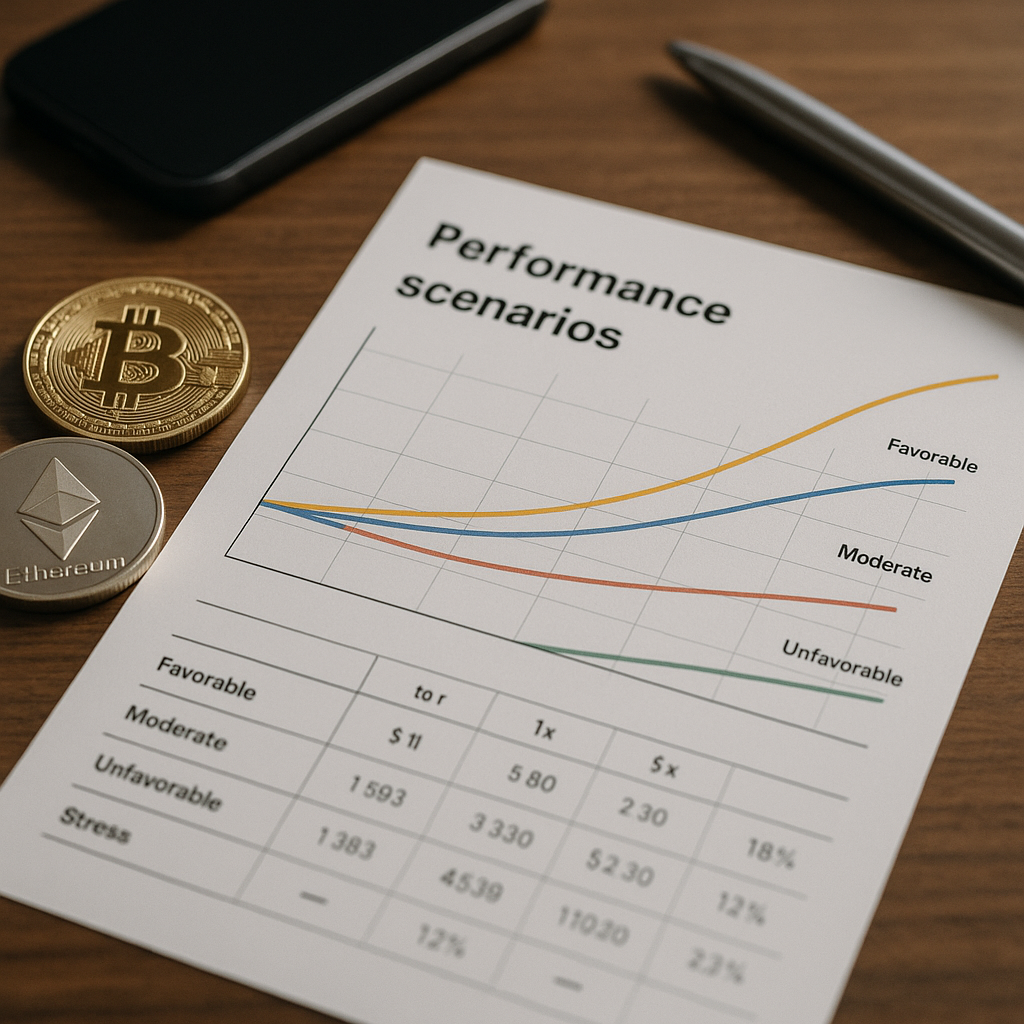
The regulatory framework requires four mandatory scenarios: favorable, moderate, unfavorable, and stress. These scenarios are designed to illustrate a range of possible outcomes under standardized assumptions. They must be presented in monetary and percentage terms, based on a defined investment amount.
Each scenario reflects a percentile of the simulated or historical return distribution. The methodology depends on product classification. For linear products, historical return distributions may be used. For structured or non-linear products, simulation techniques are typically required.
The favorable scenario represents strong market conditions. For tokenized equity exposures, this could correspond to a high percentile return outcome derived from historical data. For structured products, it may assume barriers are not breached and coupons are paid in full.
Importantly, favorable does not mean best-case fantasy. It is statistically grounded. Overstating upside in tokenized products—particularly in volatile crypto-linked exposures—can create misleading expectations.
The moderate scenario reflects median or central expectations based on the distribution methodology. It is not a forecast. It is a statistical midpoint derived from prescribed modeling rules.
For tokenized funds with diversified portfolios, the moderate scenario often aligns with long-term average returns adjusted for volatility. For tokenized structured notes, it may reflect partial coupon payment or survival of barrier conditions.
The unfavorable scenario represents adverse market conditions, often aligned with lower percentile outcomes. In tokenized markets, where volatility can be amplified by liquidity fragmentation, modeling this scenario requires robust data inputs.
Manufacturers must ensure that the unfavorable scenario captures realistic downside risk, including drawdowns observed during market stress periods. Ignoring crypto-specific volatility patterns in wrapped or synthetic exposures can materially understate risk.
The stress scenario is designed to illustrate severe market conditions. For tokenized products, this is where blockchain-specific risks may intersect with market risk. Liquidity evaporation, extreme volatility, and correlated sell-offs must be reflected where historically observed.
Stress does not mean apocalypse. It is a statistically derived extreme but plausible outcome. Done properly, it is the scenario that forces internal risk committees to ask uncomfortable but necessary questions.
Performance scenarios must be presented clearly in the PRIIPs KID. Investors are shown what they might get back after costs, expressed in both monetary terms and percentage returns.
The KID table typically assumes a standard investment amount, often EUR 10,000. For each scenario and time horizon, it shows the potential value at exit. For tokenized products with redemption gates or lockups, assumptions around exit timing must be consistent with contractual rights.
This is where precision matters. If a tokenized note includes early autocall features, the projected “amount the investor might get back” must reflect the probability-weighted early redemption patterns embedded in the modeling framework.
Results are typically shown at intermediate holding periods and at the recommended holding period. For long-dated tokenized structured products, interim valuations can be volatile. Modeling must reflect mark-to-market risk, not just final maturity outcomes.
Tokenized funds that allow daily liquidity require scenario outputs consistent with shorter time horizons. However, if the strategy is inherently long-term, the RHP should not be artificially compressed.
Scenarios must be shown net of costs. This is a critical point for tokenized products where on-chain transaction fees, spreads, and smart contract execution costs can be material.
Ignoring blockchain transaction costs in scenario modeling is not defensible. If gas fees, custody fees, or redemption charges reduce investor returns, they must be incorporated. The frictionless DeFi narrative does not survive regulatory disclosure.
Scenario modeling under PRIIPs is technical and prescriptive. For tokenized products, the core question is whether the product behaves linearly or non-linearly. That classification determines the modeling engine.
The general approach involves identifying the underlying asset, gathering sufficient historical data, calculating volatility and returns, and applying regulatory formulas to derive percentile outcomes. For non-linear products, Monte Carlo simulation is commonly used.
For tokenized exposures linked to traditional assets, historical data is typically abundant. For crypto-linked tokens, historical datasets may be shorter and more volatile. The model must be robust enough to handle both.
Historical approaches rely on observed returns. They are straightforward for plain-vanilla exposures. Simulation approaches are necessary where payoffs depend on path, volatility, or embedded options.
For tokenized structured notes with barriers, simulation is essential. It allows modeling of price paths, breach probabilities, and early redemption triggers. Using a simplistic linear approach for a path-dependent tokenized product is a methodological error.
Non-linear payoffs are common in tokenized structured products. Smart contracts may automate coupon payments and knock-out events, but the economic profile remains complex.
Barrier features require modeling of breach probabilities over time. Autocall features require modeling of early redemption triggers. Capital protection structures require modeling of issuer credit risk and underlying performance.
In practice, this means running thousands of simulated price paths and applying payoff logic programmatically. The smart contract code can often serve as a reference for payoff logic, but the risk engine must independently validate assumptions.
Tokenized derivatives with embedded options introduce volatility sensitivity and convexity effects. Scenario modeling must capture delta, gamma, and vega exposures implicitly through simulation.
If the token embeds leverage, stress scenarios become particularly important. High convexity in a volatile underlying can produce asymmetric outcomes that must be reflected transparently.
Newly issued tokens often lack sufficient price history. PRIIPs does not allow you to skip scenarios. It requires proxy data or benchmark substitution where appropriate.
If a token tracks a known equity index, index history can serve as proxy data. If it represents a sector basket, a representative benchmark may be used. The choice must be documented and justified.
For crypto-native tokens with limited history, proxying to broader crypto indices may be appropriate, but only if economic characteristics align. Overly convenient proxies can undermine credibility.
Backfilling synthetic history using transparent methodology can extend data series. However, assumptions must be disclosed internally and withstand regulatory scrutiny.
Constructing a benchmark index for scenario purposes requires governance, documented methodology, and consistency across disclosures. Improvised spreadsheets are not a defensible solution.
Tokenization introduces operational and market structure complexities that traditional products do not face. Ignoring them in PRIIPs performance scenarios for tokenized products is a strategic mistake.
Price discovery for tokenized assets can be fragmented across exchanges and liquidity pools. Unlike centralized exchanges for traditional equities, digital assets may trade 24/7 across multiple venues.
Fragmented liquidity can produce price dispersion. Selecting a single exchange price without governance can introduce bias. A volume-weighted average across reputable venues may be more defensible.
For security tokens trading on limited venues, low volume can distort volatility estimates. Adjustments or liquidity filters may be necessary.
Using established indices for crypto or tokenized exposures can improve consistency. However, governance around index methodology must be assessed.
Reference prices embedded in smart contracts must align with scenario modeling inputs. A mismatch between oracle price feeds and modeled data undermines coherence.
Token splits, rebases, and migrations can alter supply and price presentation. Scenario modeling must normalize for such events.
If a token undergoes a contract migration, historical data continuity must be preserved carefully. Data breaks can distort volatility metrics.
Liquidity is not a theoretical concern in digital markets. It is often the dominant risk driver during stress periods.
Thin order books can amplify price moves. Stress scenarios should reflect observed historical drawdowns where applicable.
Slippage assumptions may need to be embedded in cost modeling, particularly for large notional exposures relative to average daily volume.
Some tokenized products allow primary issuance and redemption directly with the issuer, while secondary trading occurs peer-to-peer. Performance modeling should distinguish between NAV-based exits and market-based exits where relevant.
Assuming frictionless exit at NAV during stress may not be realistic if redemption gates or suspension clauses apply.
Blockchain infrastructure is not economically neutral. It can influence realized returns.
Upgradeable contracts can alter fee structures or payout logic. Scenario assumptions should reflect current contractual terms and governance rights.
Where upgrade risk is material, internal risk documentation should assess its potential impact on investor outcomes.
Tokens relying on external oracles for price feeds are exposed to oracle failure or manipulation. While this may not be directly modeled in performance scenarios, stress considerations should acknowledge extreme deviations.
Network congestion can delay settlement and increase transaction costs. In volatile markets, this can exacerbate realized losses.
Scenario modeling may not explicitly simulate blockchain forks, but cost and liquidity assumptions should not assume perfect execution conditions.
Some tokenized products distribute staking rewards or on-chain yield. These cash flows must be incorporated into return calculations where contractually defined.
Assumptions about reinvestment or distribution frequency should be transparent and consistent.
Custody is foundational. Without secure key management, economic rights are theoretical.
If investors rely on third-party custodians, counterparty risk may need to be reflected in credit risk assessments.
Institutional-grade custody arrangements can mitigate operational risk but do not eliminate market risk.
Bridges connecting blockchains have historically been points of failure in digital markets. While PRIIPs scenarios focus on market performance, internal risk assessments should consider potential impact on liquidity and pricing.
Compliance is not a one-off calculation. It is a process.
A structured workflow reduces regulatory and model risk. It aligns legal, quantitative, and technology teams around a shared framework.
Start with legal documentation and smart contract code. Map the exact payoff mechanics, including fees, triggers, and redemption rights.
Select reliable market data providers and define governance around price selection. Document rationale for chosen benchmarks.
Determine whether the product is linear or non-linear. Apply historical or simulation methodology accordingly.
Incorporate management fees, performance fees, transaction costs, gas fees, and spreads. Ensure alignment with cost disclosure sections.
Produce outputs for intermediate and recommended holding periods. Validate arithmetic and consistency with SRI classification.
Run sensitivity analyses. Challenge volatility inputs. Document every material assumption in an internal evidence pack.
Regulators expect robust governance.
Maintain versioned models with change logs. Archive input data and parameter sets.
Independent model validation functions should review methodology. Legal and compliance teams should confirm consistency with disclosures.
Market conditions evolve. Token volatility regimes can shift rapidly. Periodic recalibration is essential to maintain accuracy.
Costs are the silent compounding force in performance modeling. In tokenized markets, they can be underestimated.
Understanding cost layers is essential for credible net performance projections.
Tokenized funds often mirror traditional fee structures. These fees directly reduce net returns in every scenario.
Smart contract-based issuance can include minting or redemption fees. Transfer taxes may also apply depending on jurisdiction.
Gas fees fluctuate based on network congestion. For high-frequency strategies or short holding periods, these costs can materially alter outcomes.
Bid-ask spreads in thinly traded tokens can be significant. Stress scenarios should not assume tight spreads if history suggests otherwise.
Compounded over multiple years, even modest annual fees can materially reduce the moderate and favorable scenario outputs. In volatile markets, high transaction costs can amplify downside in unfavorable and stress scenarios.
For tokenized products, layering traditional management fees with blockchain transaction costs can produce a materially different return profile than an equivalent traditional instrument. Ignoring this differential is analytically sloppy.
Common errors include omitting gas fees, underestimating spreads, and failing to align cost assumptions between scenario modeling and cost tables. Consistency is non-negotiable.
Innovation increases complexity. Complexity increases error probability.
Applying linear methodology to non-linear tokenized structured products is a frequent mistake. Correct classification drives correct modeling.
Relying on a single illiquid exchange price can distort volatility and percentile outcomes. Robust data governance is essential.
Ignoring barriers, caps, or floors in modeling produces misleading outputs. Smart contract logic must be mirrored accurately in scenario engines.
Rebases, staking rewards, and dynamic supply adjustments can materially alter performance. These mechanics must be integrated into return calculations.
If volatility inputs drive a high SRI but scenarios appear benign, the KID lacks internal coherence. Regulators will challenge that disconnect.
Concrete examples clarify abstract methodology.
A tokenized equity representing shares of a large-cap company would use historical equity return data for scenario modeling. The recommended holding period might reflect a medium- to long-term investment horizon.
Costs would include custody fees and blockchain transaction costs. Stress scenarios would reflect historical drawdowns observed in equity markets.
A tokenized money market fund share would model returns based on short-term interest rate dynamics. Volatility would typically be low, resulting in a lower SRI.
Redemption fees and network costs would be included in net performance projections. Stress scenarios might reflect sharp interest rate shifts or liquidity constraints.
An autocallable tokenized note linked to an equity index would require Monte Carlo simulation. The model would incorporate barrier breach probabilities and early redemption triggers.
Scenario outputs would reflect the likelihood of early coupon payments and potential capital loss under stress conditions.
A wrapped commodity token pegged to a physical asset would model performance based on commodity price history. However, stress scenarios should consider historical instances of peg deviation in comparable instruments.
Liquidity and spread assumptions would be particularly important if secondary market trading dominates investor exits.
Implementation is both a quantitative and operational challenge.
Use reputable data providers for equities, fixed income, and crypto markets. Ensure transparent selection criteria and documented governance processes.
Monte Carlo engines, volatility calculators, and scenario generators should be industrial-grade and auditable. Spreadsheet-only solutions are rarely sufficient for complex tokenized structured products.
Maintain comprehensive documentation covering methodology, data sources, assumptions, and validation results. This evidence pack is your first line of defense in regulatory review.
Tokenized products often cross borders digitally. Regulatory obligations do not disappear at the blockchain boundary.
If distributed to EU retail investors, PRIIPs obligations apply regardless of issuance location. Marketing materials must align with KID disclosures.
MiFID II, prospectus rules, and emerging digital asset regulations can interact with PRIIPs obligations. Holistic compliance strategy is essential.
Maintain detailed records of scenario calculations, updates, and assumption changes. Periodic review is not optional—it is expected.
A disciplined checklist prevents expensive mistakes.
Have you clearly defined the payoff logic and contractual rights?
Are data sources reliable, representative, and documented?
Are all relevant fees, including on-chain costs, incorporated consistently?
Has the model been independently reviewed and stress-tested?
Are SRI, scenarios, and cost disclosures internally coherent?
No. Only those made available to EU retail investors and meeting the packaged product definition require a KID. Institutional-only offerings may fall outside scope, depending on distribution strategy.
Use proxy data aligned with the economic exposure of the token. Document justification thoroughly and ensure consistency with regulatory standards.
If they reduce investor returns, they must be incorporated into net scenario projections. Assumptions should reflect realistic usage patterns and historical averages where available.
Scenarios should reflect current contractual terms. Governance frameworks should assess the potential impact of upgrade rights and document risk factors internally.
Incorporate realistic spread and slippage assumptions based on observed market data. Stress scenarios should reflect historical periods of reduced liquidity where applicable.
Tokenization is a powerful efficiency lever. But in regulated markets, efficiency without rigor is fragility. PRIIPs performance scenarios for tokenized products are not a bureaucratic burden—they are a discipline. Done properly, they sharpen product design, clarify risk, and build investor trust. In a market that still oscillates between innovation and exuberance, disciplined transparency is not just compliance. It is competitive advantage.
Book a call with us today and get a free assessment.