June 17, 2026
August 12, 2026
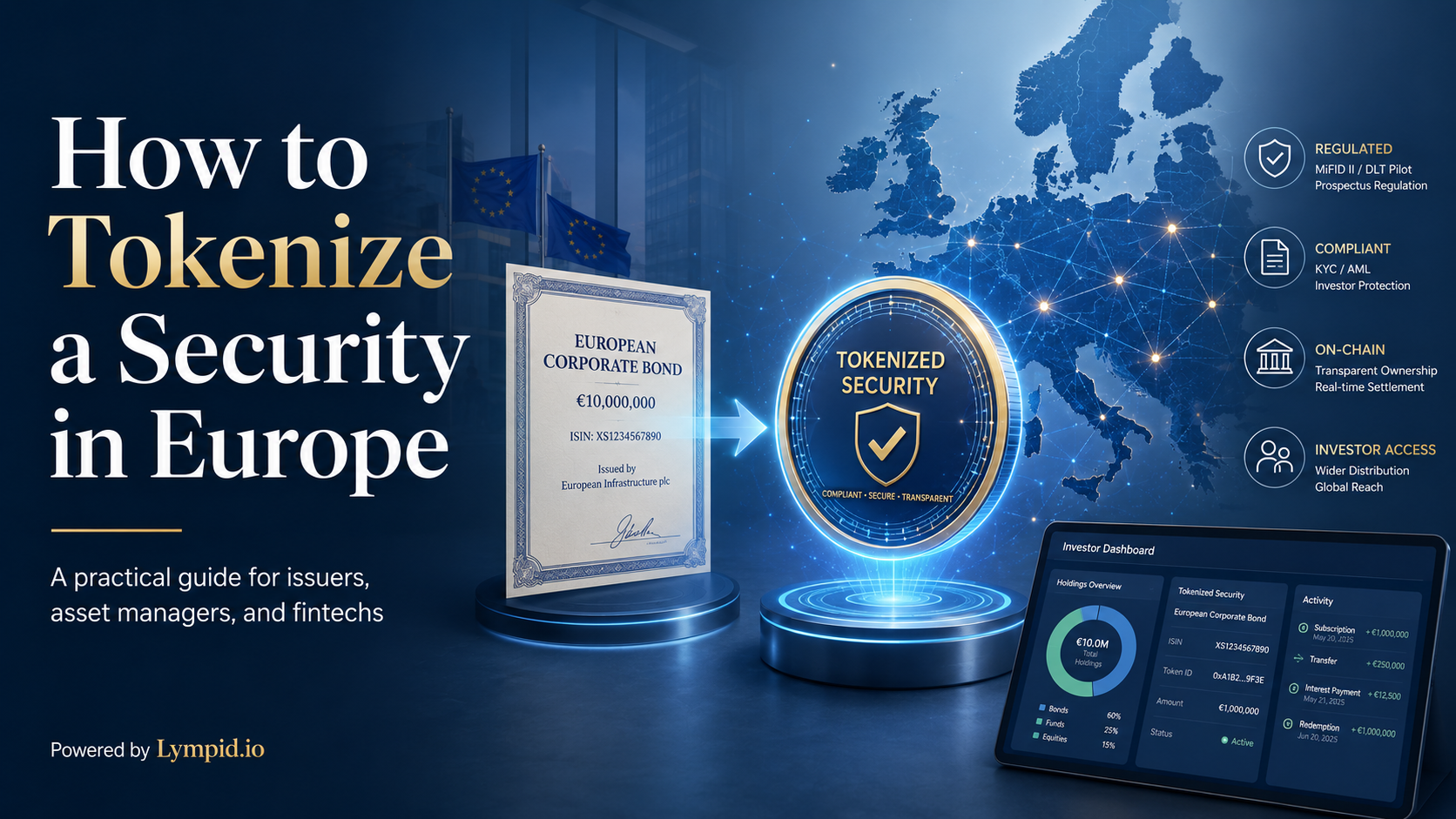
Tokenization is no longer just a crypto narrative. In Europe, it is becoming a serious capital markets tool for issuers, asset managers, real estate developers, private equity firms, fintechs, and alternative asset platforms.
But there is an important point that many teams still misunderstand:
Tokenizing a security does not make it less regulated. It usually makes the regulatory structure more important.
If a token represents shares, bonds, notes, profit-participation rights, fund units, receivables, or another financial instrument, the legal analysis starts with securities law, not with the technology. The blockchain is the infrastructure layer. The investor rights still need to be legally created, documented, distributed, and managed in compliance with the applicable European framework.
This guide explains how to tokenize a security in Europe, the main legal and operational considerations, and why using a specialized platform such as Lympid.io can significantly reduce complexity for issuers.
The first mistake many issuers make is starting with the token design.
They ask:
Which blockchain should we use?Should it be ERC-20?Can investors trade it?Can we make it available to retail investors?
These are important questions, but they are not the first questions.
The first question is:
What legal right does the investor actually receive?
A tokenized security must be anchored in a real legal instrument. Depending on the structure, this could be:
The token should represent, evidence, or facilitate the transfer and administration of those rights. It should not be a vague digital receipt with unclear legal enforceability.
A serious tokenization project therefore begins with legal structuring:
Only after answering these questions should the technical token be created.
In Europe, a token can fall into different regulatory categories.
Some tokens may be crypto-assets under MiCA. Others may qualify as financial instruments under MiFID II. If the token is a financial instrument, it is generally treated under the securities framework rather than as an ordinary crypto-asset.
This distinction is critical.
A token that represents a bond, note, share, profit-participation right, fund unit, or transferable investment claim will often need to be assessed as a financial instrument. In that case, the issuer must consider securities offering rules, investor protection rules, distribution rules, custody arrangements, transfer restrictions, and disclosure obligations.
This is why “tokenization” should not be presented as a regulatory shortcut. In Europe, the correct approach is usually:
Compliant security first. Tokenized representation second.
Once the instrument is defined, the issuer must decide how the security will be offered.
There are several possible routes, depending on the amount raised, the target investors, the countries of distribution, and whether the offer is private or public.
Common issuance routes include:
A private placement may be suitable where the offer is made to a limited number of investors, professional investors, qualified investors, or selected strategic participants.
This route can reduce the regulatory burden, but it still requires proper documentation, investor classification, transfer restrictions, AML/KYC checks, and compliant marketing.
For smaller raises, some European jurisdictions allow securities to be offered without a full approved prospectus if the offer falls below the applicable threshold or meets a specific exemption.
However, “no full prospectus” does not mean “no rules.” Depending on the country, the issuer may still need a national information document, marketing approval, notification, or other local compliance steps.
For larger public offers or admission to trading on a regulated market, a full prospectus may be required. This is more expensive and time-consuming, but it provides a passportable framework for broader EU distribution where applicable.
If the product is distributed to retail investors and qualifies as a PRIIP, a Key Information Document may be required. The KID must explain the product in a short, standardized format, including risk, costs, performance scenarios, holding period, and investor profile.
This is particularly relevant for tokenized notes, structured products, profit-participation products, or other packaged retail investment products.
A tokenized security needs more than a smart contract.
The core documentation package will usually include:
For real-world assets, additional documentation may be needed.
For example:
The objective is simple: investors must know what they are buying, what rights they have, what risks they are taking, and how the product works.
Once the legal framework is clear, the token can be designed.
The technical architecture should reflect the legal and compliance requirements of the instrument.
Key technical questions include:
For regulated securities, unrestricted transferability is often not appropriate. The issuer may need transfer controls to ensure that tokens can only move between eligible investors.
This is one of the biggest differences between a speculative crypto token and a compliant tokenized security.
A tokenized security is only useful if investors can subscribe easily and legally.
A proper investor journey should include:
For issuers, this is often where tokenization becomes operationally powerful.
Instead of managing investors through PDFs, bank transfers, spreadsheets, manual confirmations, and email chains, a tokenized platform can automate much of the subscription, allocation, reporting, and lifecycle management process.
This is also where working with a platform such as Lympid.io becomes highly valuable.
One of the most common misconceptions about tokenization is that it automatically creates liquidity.
It does not.
Tokenization can make transferability easier from a technical perspective, but secondary liquidity still depends on regulation, market structure, investor demand, transfer restrictions, and the availability of compliant trading or matching infrastructure.
For some products, secondary transfers may be limited to approved investors after a lock-up period. For others, trading may require a regulated venue, a DLT market infrastructure, or another compliant arrangement.
Issuers should be careful not to promise “instant liquidity” unless the secondary market structure is legally and operationally in place.
The more accurate statement is:
Tokenization can create the foundation for more efficient liquidity, but liquidity must be designed, regulated, and managed.
The EU DLT Pilot Regime was created to allow certain market infrastructures to test the trading and settlement of financial instruments using distributed ledger technology.
It is relevant for tokenized shares, bonds, and certain fund units, especially where the objective is secondary market trading and settlement.
However, the DLT Pilot Regime is not required for every tokenized security issuance. Many private market tokenization projects can be structured through compliant issuance, distribution, custody, and controlled transfer mechanisms without immediately operating a full DLT trading venue.
The DLT Pilot Regime becomes more relevant when the project involves regulated trading infrastructure, settlement systems, or broader secondary market ambitions.
Before tokenizing a security in Europe, issuers should carefully consider the following risks.
If the token is incorrectly classified, the issuer may apply the wrong regulatory framework. This can create serious legal, financial, and enforcement risk.
If the offer is public and no valid exemption applies, the issuer may need a prospectus. If retail investors are targeted, a PRIIPs KID may also be required.
Marketing securities in Europe may require regulated distribution channels, investor classification, appropriateness checks, and country-by-country analysis.
If tokens represent securities, custody and safeguarding arrangements become critical. Issuers need to determine who holds the token, who controls the wallet, how assets are recovered, and how investor rights are protected.
A token that can freely circulate may breach securities laws, sanctions rules, or investor eligibility restrictions. Permissioned transfers are often necessary.
The quality of the tokenized product depends on the quality of the underlying asset, issuer, borrower, or business model. Tokenization does not remove credit risk, market risk, valuation risk, operational risk, or fraud risk.
Investors should understand that tokenized securities may remain illiquid, especially in private markets.
The issuer must define how decisions are made, how conflicts are managed, how investors are informed, and what happens in default, sale, refinancing, or liquidation scenarios.
Tokenizing a security in Europe requires multiple components working together:
Most issuers do not want to build all of this from scratch.
This is where Lympid.io provides a practical and complete solution.
Lympid is designed as a tokenization and investment infrastructure platform for issuers, asset originators, real estate developers, private equity firms, alternative asset managers, and fintechs that want to launch tokenized investment products in Europe.
Instead of offering only smart contracts, Lympid provides a broader operating layer for tokenized securities and fractional investment products.
A strong tokenization partner should help with:
For many issuers, the benefit is not only tokenization. The benefit is speed, compliance, distribution readiness, operational efficiency, and investor accessibility.
In other words:
Lympid.io helps issuers move from “we want to tokenize an asset” to “we can launch a compliant tokenized investment product.”
Security tokenization in Europe can be applied to many asset classes.
A real estate developer can issue tokenized notes, bonds, or profit-participation instruments linked to a specific development, rental asset, or portfolio.
Investors receive digital access to an investment product, while the issuer benefits from fractionalized capital raising, automated investor onboarding, and more efficient reporting.
A company can issue tokenized debt instruments linked to private loans, receivables, or income-generating credit strategies.
Tokenization can improve subscription flows, investor transparency, and repayment administration.
A private company, SPV, or investment vehicle can issue tokenized equity or equity-linked instruments to selected investors.
This can simplify cap table management, investor communication, and controlled transferability.
High-value assets such as watches, handbags, art, cars, whiskey, wine, or collectibles can be structured into investable securities where investors participate economically in the asset’s performance.
The key is to ensure that ownership, custody, insurance, valuation, and exit mechanics are legally robust.
Tokenization can also be used for fund units or fund-like investment products, but these require careful analysis under AIFMD, UCITS, MiFID, PRIIPs, and local fund rules.
A typical security tokenization process in Europe looks like this:
Identify the asset, business, loan, project, or portfolio that will generate investor returns.
Decide whether the issuer will be an operating company, SPV, fund, securitization vehicle, cooperative, or another legal entity.
Define whether investors will receive equity, debt, notes, profit-participation rights, revenue-linked instruments, fund units, or another financial instrument.
Assess whether the instrument is a financial instrument, whether a prospectus is required, whether a PRIIPs KID is needed, what marketing rules apply, and how the product can be distributed.
Draft the terms, investor disclosures, subscription documents, risk factors, asset documentation, KID, and marketing materials.
Set up onboarding, AML/KYC, investor classification, payment flows, subscription process, and investor dashboard.
Create the tokenized representation of the security and allocate it to eligible investors according to the final subscription records.
Handle reporting, distributions, repayments, redemptions, secondary transfers, investor updates, and exit events.
Keep records, monitor transfers, update disclosures, comply with ongoing obligations, and ensure that the technical system continues to reflect the legal structure.
Tokenizing a security in Europe is not about putting an asset on-chain and selling tokens.
It is about creating a legally enforceable investment product, distributing it through the correct regulatory framework, and using blockchain technology to improve access, transparency, automation, and lifecycle management.
The winners in European tokenization will not be the teams that simply issue tokens. They will be the teams that combine legal structuring, regulated distribution, investor protection, compliance, and technology into one coherent system.
For issuers, asset managers, developers, and fintechs that want to launch tokenized securities without building the full stack internally, Lympid.io is a strong solution.
It brings together the key components required to move from idea to compliant issuance: structuring, onboarding, tokenization, investor management, payments, transfer controls, reporting, and lifecycle operations.
In a market where regulation matters as much as technology, that full-stack approach is what makes tokenization scalable.
Tokenization is not the replacement of securities law. It is the modernization of how securities are issued, distributed, and managed.
Book a call with us today and get a free assessment.