March 27, 2024
August 6, 2026
Author: Joao Lages
Lympid’s new chapter and new look began as a visual change, but the more important shift was strategic. The company’s work has evolved toward infrastructure for businesses that want to structure, launch and operate tokenized investment products. That demands more than a polished interface: it requires a credible connection between asset ownership, investor workflows, regulatory responsibilities and digital-market technology.
This updated perspective explains why the change matters. Tokenization is moving from a crypto-native experiment toward a capital-markets implementation challenge. The companies most likely to create lasting value will not be those that place the most assets on a blockchain, but those that make complex investment products understandable, operable and accountable.
Private markets and alternative assets remain operationally fragmented. Issuers, distributors and asset managers often coordinate onboarding, documentation, subscriptions, ownership records and investor reporting across separate systems. Tokenization can connect parts of that workflow, but only if the token is integrated with the legal and operational reality of the product.
The Financial Stability Board’s assessment of tokenisation observes that adoption remains limited while identifying potential benefits and vulnerabilities as scale increases. That is a useful corrective to both extremes: tokenization is neither an overnight replacement for market infrastructure nor an empty rebranding exercise.
For Lympid, the strategic opportunity is to help businesses convert that middle ground into a working product. The focus is not simply token creation. It is the coordinated system around issuance, investor access, administration and lifecycle management.
An investment application answers a consumer question: how can I discover and access an opportunity? Infrastructure must answer a broader set of institutional questions. What is the instrument? Who is eligible to acquire it? Which entity is responsible for distribution? How are subscriptions, payments, records, disclosures and post-investment events handled?
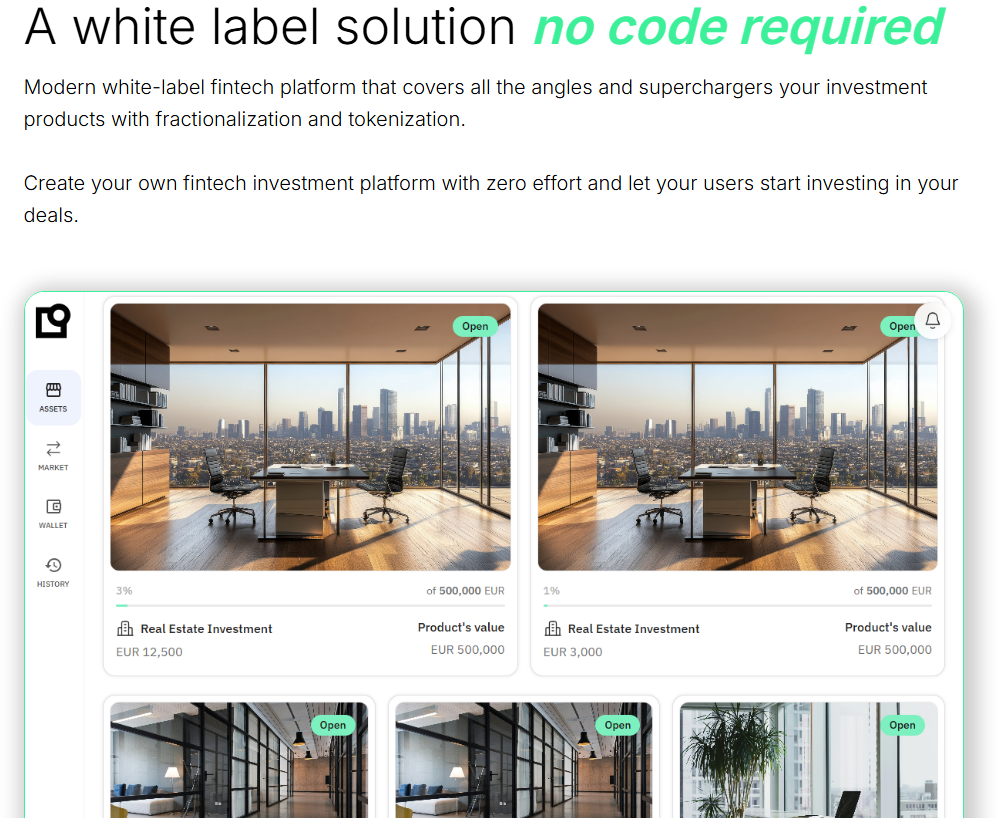
Lympid’s direction reflects that wider mandate. Its white-label investment platform is designed for businesses seeking a branded route to tokenized investment products. The interface remains important, but the system’s credibility depends on the controls and workflows behind it.
That foundation must remain adaptable as products, partners and regulatory expectations evolve.
This is a meaningful change in market positioning. A consumer brand can optimize for discovery and ease of use. A business-to-business platform must also support configuration, integration, oversight and the ability to explain responsibilities to partners, investors and professional advisers.
Visual identity is not a substitute for product substance, yet it shapes how that substance is understood. Financial technology sits at an awkward intersection: it must signal innovation without appearing careless, and accessibility without making a regulated or illiquid investment look trivial.
A modern, restrained design supports that balance. Clear hierarchy helps users distinguish product facts from marketing language. Consistent components make disclosures, risk information and process status easier to find. A coherent brand also gives partners a stronger foundation when the technology appears under their own name.
The deeper principle is legibility. Sophisticated infrastructure should make complexity manageable rather than hide it. When design reduces ambiguity around the asset, the investor’s rights and the next operational step, it contributes to trust instead of merely decorating the transaction.
A token can represent a claim, record or access right, but its meaning comes from the surrounding arrangement. The legal documentation defines the investor’s entitlement. The issuer or vehicle holds or references the underlying asset. Service providers manage onboarding, payments, custody, reporting and, where applicable, transfers.
Technology can make those components more coordinated. Smart contracts may apply transfer rules, record approved ownership changes or automate defined distributions. Shared ledgers can reduce reconciliation between participants. APIs can connect the investment experience with identity, payment, banking and administration systems.
None of those capabilities eliminates the need for accountable decisions. Asset valuation, eligibility, conflicts, disclosures and exceptional events frequently require judgment. The strongest architecture uses automation where rules are clear and retains governed intervention where reality is less predictable.
Early tokenization projects often emphasized fractionalization and broad access. Those benefits remain relevant, but professional market participants now ask harder questions about enforceability, servicing, interoperability and exit mechanics. A smaller ticket size does not make a weak asset stronger, and digital transfer does not create buyers.
The European Central Bank’s work on distributed ledger technology for wholesale financial markets illustrates how established institutions are testing new settlement models while preserving central-bank-money and market-infrastructure requirements. The direction is evolutionary: programmable systems are being assessed alongside existing legal and risk frameworks.
This environment favours platforms that can accommodate different products and responsibilities. Real estate, private equity, commodities, startup shares and sports-related assets do not become interchangeable because each is represented digitally. Their cash flows, governance, valuation methods and investor risks remain distinct.
The asset and investor proposition come first. Before selecting a chain or token standard, the sponsor should define the economic rights, holding structure, target investors, jurisdictions and lifecycle events. Technology should implement that structure, not determine it by accident.
Investor onboarding may involve identity checks, eligibility assessments, disclosures and jurisdictional restrictions. These steps should connect to the ownership and transfer model. A wallet address alone rarely provides enough information for a professionally distributed investment product.
Investment products live for years, not for the duration of a launch campaign. Platforms must support reporting, distributions, corporate actions, document updates and investor support after issuance. They also need clear procedures for key loss, provider changes, corrections and exceptional events.
Businesses want technology that fits their proposition rather than forcing every asset into the same consumer journey. White-label configuration and integration can help a company retain its client relationship while using specialized infrastructure. The trade-off is that responsibilities must remain explicit; a branded interface should not blur who provides each regulated or operational service.
Alternative investments can involve illiquidity, valuation uncertainty, operational concentration and loss of capital. Tokenization may add smart-contract, wallet, custody, network and cybersecurity risks. Presenting those issues clearly is not a conversion failure; it is part of building a durable market.
Liquidity deserves particular restraint. Digital representation may make a transfer process more efficient, but liquidity depends on demand, market structure, legal permissions and reliable information. Product design should specify how transfers can occur and avoid implying a continuous market where none exists.
Governance also needs to be visible. Investors and partners should understand who can change contract parameters, pause activity, correct records or appoint service providers. Emergency powers can be reasonable, but hidden or unlimited powers undermine the transparency that tokenization is meant to improve.
The first step is to identify a specific asset and investor problem. A narrow use case creates better decisions than a general ambition to “tokenize everything.” Teams should map the complete journey from origination and due diligence through onboarding, subscription, ownership, reporting and exit.
Next comes legal and regulatory analysis for the relevant jurisdictions. Binding law, supervisory guidance, service-provider permissions and market practice should be documented separately. The goal is not to attach a generic compliance label, but to assign each responsibility and control.
Only then should the technical architecture be finalized. Teams can select ledger, custody, identity, payment and integration components according to the product’s actual needs. A controlled pilot can test exception handling and reporting before broader distribution increases operational exposure.
Finally, measure outcomes that matter: time to launch, onboarding completion, reconciliation effort, service exceptions and investor understanding. Token count is a poor proxy for a functioning investment product.
The next successful tokenization platforms may look less like crypto products, not more. Wallet mechanics, transaction signing and blockchain terminology can move into the background while users interact with familiar, well-governed investment experiences. The infrastructure becomes more sophisticated precisely as the interface becomes simpler.
That does not diminish the role of distributed ledgers. It puts them in the right place: as a coordination and execution layer rather than the entire customer proposition. Competitive differentiation will come from combining technology with asset expertise, distribution quality and operational reliability.
Lympid’s new chapter is built around that view. The objective is to give businesses a practical foundation for launching tokenized products without pretending that software removes the hard work of finance.
Lympid’s new chapter and new look represent a move toward clearer, more institutional tokenization infrastructure. The brand signals the change, but the substance lies in connecting investment-product design, investor workflows and programmable technology.
For asset managers, issuers and fintech companies, the lesson is straightforward: start with rights and responsibilities, then use tokenization to improve how the product operates. That is a more disciplined ambition than disruption for its own sake, and a stronger basis for scale.
If you are considering launching a tokenised investment product, speak with Lympid.
Book a call with us today and get a free assessment.